Candlestick, Bar, and Line Charts Compared
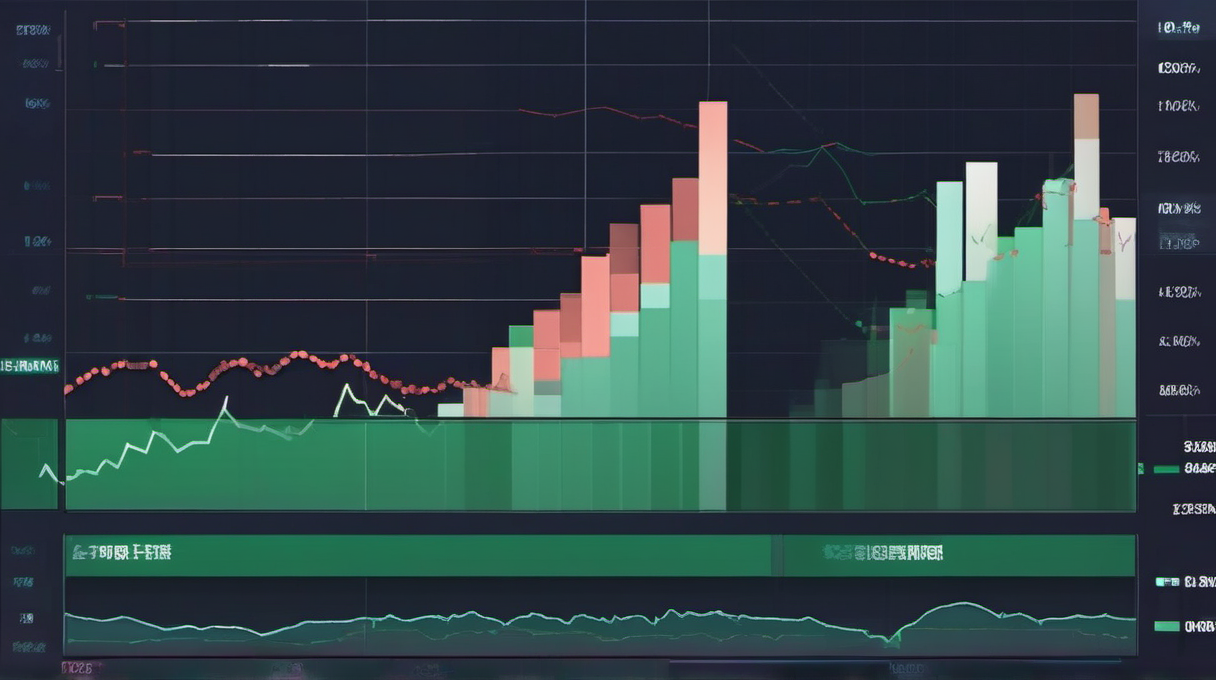
What Each Chart Type Displays
Technical analysis relies on price charts to visualize market data. The three most common chart types—line, bar, and candlestick—each present the same underlying price information in different ways. Understanding their construction helps analysts choose the right tool for specific analytical tasks.
Line charts plot a single data point per time period, typically the closing price, and connect these points with a continuous line. This creates the simplest visual representation of price movement over time.
Bar charts (also called OHLC charts) display four data points per period: Open, High, Low, and Close. Each bar consists of a vertical line spanning the high to low range, with small horizontal ticks marking the open (left side) and close (right side).
Candlestick charts present the same four data points as bar charts but use a filled or hollow rectangular body to show the relationship between open and close. The thin lines extending above and below the body, called wicks or shadows, represent the high and low.
Chart Construction Details
Line Chart Construction
A line chart requires only one value per period. For a daily chart showing five trading days with closing prices of $50.00, $51.25, $50.75, $52.00, and $51.50, the chart simply connects these five points in sequence.
Information contained: Price at one moment per period (usually close) Information excluded: Intraday range, opening price, price volatility within the period
Bar Chart Construction
For the same five-day period with this data:
- Day 1: Open $49.50, High $50.50, Low $49.25, Close $50.00
- Day 2: Open $50.00, High $51.75, Low $49.75, Close $51.25
- Day 3: Open $51.25, High $51.50, Low $50.25, Close $50.75
- Day 4: Open $50.75, High $52.25, Low $50.50, Close $52.00
- Day 5: Open $52.00, High $52.50, Low $51.00, Close $51.50
Each bar shows:
- Vertical line from $49.25 to $50.50 (Day 1 range)
- Left tick at $49.50 (open)
- Right tick at $50.00 (close)
The daily range calculation: High minus Low = $50.50 - $49.25 = $1.25 for Day 1.
Candlestick Construction
Using the same Day 1 data (Open $49.50, High $50.50, Low $49.25, Close $50.00):
Since Close ($50.00) > Open ($49.50), this is a bullish candle:
- Body spans from $49.50 (bottom) to $50.00 (top)
- Body is typically hollow or colored green/white
- Upper wick extends from $50.00 to $50.50 ($0.50 length)
- Lower wick extends from $49.50 to $49.25 ($0.25 length)
- Body height: $50.00 - $49.50 = $0.50
For a bearish candle where Close < Open, the body would be filled or colored red/black, with the open at the top and close at the bottom.
Information Density Comparison
| Chart Type | Data Points per Period | Trend Visibility | Volatility Visibility | Pattern Recognition |
|---|---|---|---|---|
| Line | 1 | High | Low | Limited |
| Bar | 4 | Moderate | High | Moderate |
| Candlestick | 4 | Moderate | High | High |
Line charts excel at showing long-term trend direction because they eliminate noise from intraday fluctuations. A 10-year line chart makes major trends immediately visible.
Bar and candlestick charts convey identical information but present it differently. Candlesticks make the open-close relationship instantly visible through body color, while bar charts require comparing the positions of two small ticks.
Worked Example: Reading the Same Day Three Ways
Consider this trading day for Stock XYZ:
- Open: $45.00 at 9:30 AM
- High: $47.25 at 11:15 AM
- Low: $44.50 at 2:30 PM
- Close: $46.75 at 4:00 PM
Line chart shows: A single point at $46.75. If yesterday's close was $45.25, the line slopes upward, indicating a gain of $1.50 (3.3%).
Bar chart shows: A vertical line from $44.50 to $47.25 (total range $2.75). Left tick at $45.00, right tick at $46.75. The right tick being higher than the left indicates a positive session.
Candlestick shows: A hollow/green body from $45.00 to $46.75 (body height $1.75). Upper wick of $0.50 ($47.25 - $46.75). Lower wick of $0.50 ($45.00 - $44.50).
The candlestick immediately communicates:
- Buyers pushed prices up from open to close (bullish body)
- The stock traded higher than the close (upper wick indicates selling pressure near the high)
- The stock traded lower than the open (lower wick indicates buying support near the low)
Practical Applications
When to Use Line Charts
Line charts work best for:
- Long-term trend identification across multiple years
- Comparing multiple securities on the same chart (overlay analysis)
- Presentations to non-technical audiences
- Identifying major support and resistance levels without noise
The CMT Association curriculum notes that line charts remain useful for identifying broad market cycles despite their limited information content.
When to Use Bar Charts
Bar charts serve well for:
- Analyzing markets with no meaningful open (like 24-hour forex)
- Fitting more data on screen (bars are narrower than candles)
- Traders accustomed to this format from decades of use
When to Use Candlestick Charts
Candlestick charts are preferred for:
- Short-term pattern recognition (doji, hammer, engulfing patterns)
- Quick visual assessment of buyer/seller strength
- Identifying reversal signals based on body-to-wick relationships
A doji pattern, for example, occurs when Open and Close are nearly equal, creating a small or nonexistent body. This is instantly visible on a candlestick chart but harder to spot on a bar chart.
Limitations and Considerations
All three chart types share common limitations:
- Past price patterns do not guarantee future results
- Charts show only price and time, not fundamental value
- Patterns that appear significant may be random noise
Specific limitations by type:
- Line charts hide intraday volatility that may be relevant for risk management
- Bar and candlestick charts can appear cluttered on long timeframes
- Candlestick patterns developed for Japanese rice markets centuries ago may not translate perfectly to modern electronic markets
Data quality matters: All chart types depend on accurate OHLC data. Thinly traded securities may show price spikes that reflect single trades rather than meaningful price discovery.
Timeframe Considerations
The same chart type conveys different information across timeframes:
- 1-minute candles: Each candle represents 60 seconds of trading. Useful for intraday scalping, but prone to noise.
- Daily candles: Each candle represents one trading session. Standard for swing trading analysis.
- Weekly candles: Each candle aggregates five trading days. Reduces noise for position traders.
- Monthly candles: Each candle represents roughly 21 trading days. Suitable for long-term trend analysis.
A weekly candlestick would show:
- Open: Monday's opening price
- High: The highest price reached during the week
- Low: The lowest price reached during the week
- Close: Friday's closing price
Next Steps
-
Open your charting platform and view the same security using all three chart types on the same timeframe to observe how information presentation differs.
-
Practice calculating candlestick body size and wick lengths manually for 10 consecutive trading days to build intuition for interpreting these measurements.
-
Compare a 1-year daily candlestick chart against a 1-year line chart for the same security to see how detail is gained or lost.
-
Document which chart type you find most useful for your specific trading timeframe and decision-making process.
-
Review the CMT Association's technical analysis curriculum section on price charts for additional context on professional applications.
Related Articles
How Technical Signals Tie into Macro Context
Federal Reserve policy, earnings seasons, and economic cycle positioning significantly affect the reliability of technical breakouts, mean reversion signals, and momentum indicators.
Momentum Oscillators: RSI, Stochastics, and MACD
Detailed formulas and worked examples for three essential momentum indicators, including standard thresholds, divergence analysis, and practical limitations.

Tax Considerations for High-Frequency Trading
Navigate wash sale rules, mark-to-market elections, and tax rate differentials that determine whether frequent trading is profitable after taxes.