Humanitarian Crises and Market Sentiment
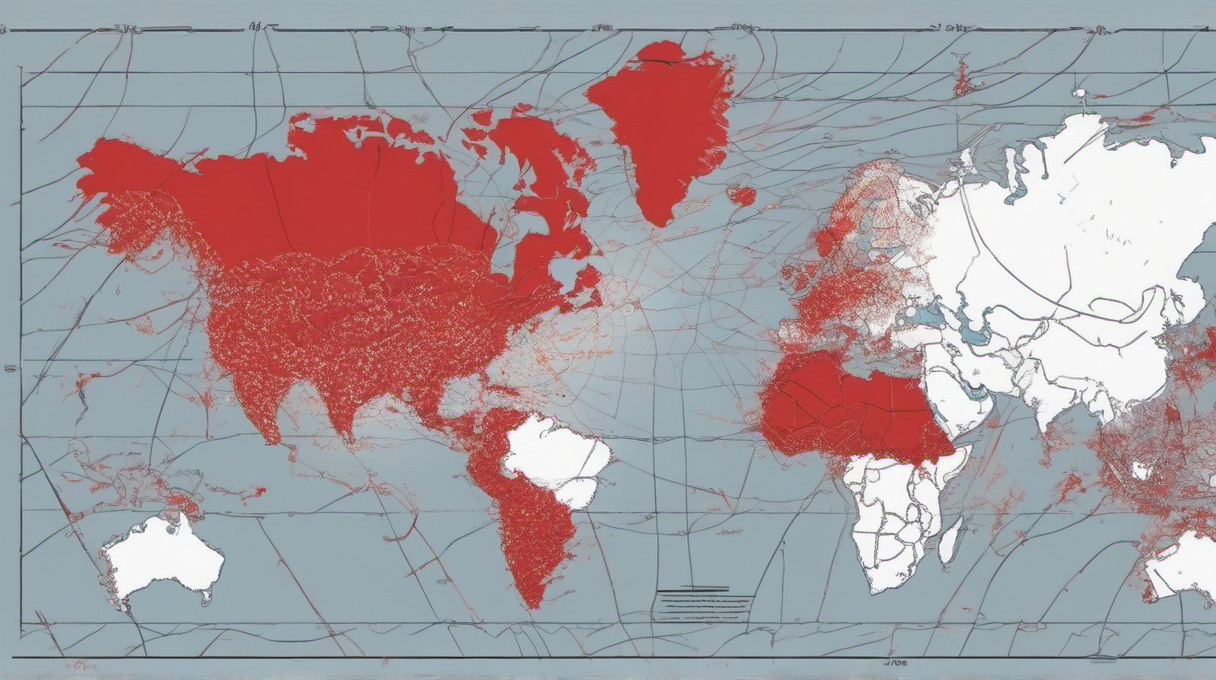
When a humanitarian disaster dominates headlines, your portfolio feels it before the economic data catches up. Implied volatility typically surges 15-40% above baseline within the first week of a major crisis, even when the affected region represents less than 2% of global GDP (Baker, Bloom & Davis, 2016). The pattern repeated through 2024-2025: Gaza, Sudan, and Ukraine each triggered sentiment shocks that moved global markets far beyond their direct economic footprint. What actually works isn't ignoring these events or panic-selling into them. It's separating the sentiment spike from the fundamental repricing, and positioning accordingly.
How Crises Actually Move Markets (The Transmission Channels)
Humanitarian events don't move markets through a single mechanism. They travel through four distinct channels, each with different timing, magnitude, and duration. Understanding which channel is active tells you whether to sit tight, hedge, or lean in.
The risk-off cascade
Large-scale human suffering triggers flight-to-safety behavior almost immediately. You see it within hours: equity indices fall (especially emerging markets), Treasury yields decline as safety demand overwhelms fiscal concerns, gold rises, and safe-haven currencies like the dollar, yen, and Swiss franc strengthen. Credit spreads widen across the board.
The point is: the risk-off rotation prices fear, not fundamentals. When the Nikkei fell 17.5% in three trading days after the 2011 Japan earthquake and tsunami, 10-year JGB yields actually dropped 8 basis points despite massive fiscal implications ahead. Safety demand dominated rational assessment.
The supply chain amplifier
Crises hitting production regions create uncertainty about future supply that almost always overshoots the actual disruption. The 2011 Thailand floods affected 25% of global hard disk drive production. HDD prices rose 80-150%, despite actual supply loss of roughly 28% for one quarter. Sentiment-driven hoarding (and the fear of hoarding by competitors) amplified the price response well beyond the physical disruption.
Why this matters: if you hold companies dependent on supply chains running through crisis zones, the market will reprice your holdings based on worst-case supply assumptions, not base-case. Your window to hedge is before that repricing completes (usually 48-72 hours).
The policy uncertainty premium
Humanitarian crises force government responses with unpredictable scope and duration. Markets hate this. During the 2015 European refugee crisis, sectors exposed to border security and migration policy saw implied volatility rise 25% above the market average. Investors couldn't model the policy path, so they priced in maximum uncertainty.
In 2024-2025, the World Bank estimated Gaza infrastructure damage at $18.5 billion, with housing accounting for 72% of costs. The market impact extended far beyond the region: defense stocks, energy names, and shipping companies repriced based on escalation probabilities that shifted daily with diplomatic developments.
The media intensity multiplier
This is the channel most investors underestimate. Events receiving front-page coverage in major outlets generate 2-3x larger market reactions than equivalent events with less prominent coverage (Tetlock, 2007). The mechanism is straightforward: media intensity drives attention, attention drives emotional response, and emotional response drives trading volume.
Media intensity (driver) -> Attention allocation (mechanism) -> Emotional response (amplifier) -> Trading volume spike (action) -> Sentiment overshoot (outcome)
What matters here: monitor the ratio of media coverage to actual economic impact. When coverage is intense but economic exposure is modest, you're looking at a sentiment overshoot that will mean-revert.
Reading the Sentiment Dashboard (What Numbers Actually Matter)
You need a small, reliable set of indicators to distinguish genuine risk repricing from temporary fear spikes. Here's what to watch and what each reading tells you.
| Indicator | Normal Range | Elevated Stress | Acute Crisis | What It's Telling You |
|---|---|---|---|---|
| VIX Index | 12-20 | 25-35 | 35+ | Equity fear pricing |
| MOVE Index | 60-100 | 120+ | 150+ | Bond market uncertainty |
| CDX IG Spreads | 50-80 bps | 100+ bps | 130+ bps | Credit risk perception |
| Put/Call Ratio | 0.7-1.0 | 1.2+ | 1.5+ | Hedging demand intensity |
The test: if VIX spikes 30%+ but credit spreads barely move, you're looking at an equity sentiment shock (not a fundamental credit deterioration). That distinction matters enormously for how you respond.
The VIX pattern across humanitarian events
Pure humanitarian events (without direct economic disruption to major economies) typically cause 10-30% VIX increases with normalization within 2-4 weeks. Events combining humanitarian and economic disruption cause larger, longer-lasting volatility. The 2024-2025 period confirmed this: the VIX spiked above 20 multiple times on geopolitical headlines, but the pattern of spike-and-revert held for events without direct US economic transmission.
COVID-19 remains the outlier that proves the rule. When the VIX hit 82.7 in March 2020 (a 503% increase from its February baseline), markets were pricing a genuine global economic shutdown, not just humanitarian sentiment. The normalization took 180+ trading days because the fundamental disruption was real.
Which Sectors Get Hit (and Which Quietly Benefit)
Different sectors respond to humanitarian crises based on their exposure to affected regions, supply chain dependence, and consumer sentiment sensitivity. Mapping your portfolio against these patterns before a crisis arrives is far more useful than scrambling during one.
| Sector | Typical Reaction | Why |
|---|---|---|
| Defense/Aerospace | +3% to +10% first week | Security spending anticipation |
| Insurance | -5% to -20% | Direct claims exposure (catastrophe-linked) |
| Energy | +5% to +15% | Supply disruption fears (if producing region hit) |
| Consumer Discretionary | -2% to -5% | Consumer confidence decline |
| Utilities / Staples | Flat to +2% | Defensive rotation beneficiaries |
The disciplined response for sector exposure isn't avoiding all crisis-sensitive names. It's knowing your portfolio's sentiment beta before the event arrives. A portfolio overweight insurance and underweight defense has a very different crisis profile than the inverse.
Separating the Spike from the Shift (Short-Term vs. Long-Term)
This is where most investors get it wrong. They either treat every sentiment spike as permanent (selling into the panic) or dismiss every crisis as temporary (missing genuine structural shifts). The data gives you a framework.
Short-term sentiment shocks (days to weeks)
The S&P 500 has recovered initial crisis-driven losses within 20-60 trading days in approximately 75% of humanitarian events without direct US economic impact. These recoveries happen because the initial move was driven by uncertainty and media intensity, not by lasting changes to earnings or cash flows.
Detection signals for short-term shocks:
- VIX elevated but credit spreads stable
- Fund flows show rotation (not withdrawal)
- Analyst earnings estimates unchanged
- Supply chain disruption under 90 days
Long-term structural repricing (months to years)
Some crises genuinely change the landscape. The 2011 Japan earthquake didn't just cause a temporary Nikkei decline; it triggered a structural shift in energy policy. Japan took 20% of its nuclear capacity permanently offline, creating a sustained impact on the utilities sector for a decade-plus. Companies dependent on just-in-time Japanese components restructured entire supply chains.
The 2024-2025 period added new examples. The Sudan civil war displaced over 10 million people internally (the largest internal displacement in recorded history), reshaping regional trade routes and commodity flows in ways that won't reverse quickly. The Gaza conflict wiped out an estimated $50 billion in investment according to the UN Development Program, with reconstruction timelines stretching into the 2030s.
Detection signals for structural shifts:
- Supply chain disruption exceeds 90 days (inventory buffers exhausted)
- Policy response creates permanent regulatory change
- Consumer or corporate behavior shifts structurally
- Infrastructure damage requires multi-year rebuild
The point is: the duration of the disruption, not the severity of the headlines, determines whether you're facing a trading opportunity or a portfolio restructuring event.
The ESG Dimension (Where Values Meet Returns)
ESG performance has emerged as a measurable factor in crisis resilience. Research from 2024-2025 shows that firms with higher ESG scores experience smaller drawdowns during humanitarian-crisis-driven selloffs and recover faster than lower-rated peers. This isn't feel-good marketing; it's measurable alpha during stress events.
A 2025 study in Cogent Economics & Finance found that the VIX (VIXCLS) emerged as the most influential risk factor for ESG stock indices during global crises, confirming that ESG portfolios are not immune to sentiment but do show differential sensitivity.
Despite political headwinds in the US, sustainable investing remained steady through 2025. Nearly 70% of institutional investors maintained their commitment to ESG integration, though the language shifted from "values" to "risk management" (a rebranding more than a retreat). The practical implication: ESG screens function as a partial crisis buffer, not because companies are virtuous, but because companies with strong governance and stakeholder management tend to navigate disruptions better.
Why this matters: if you're building a portfolio with crisis resilience in mind, ESG scoring isn't a moral choice; it's a risk-management input with measurable performance differential during the exact scenarios this article describes.
Five Mistakes That Cost You Money During Crises
Mistake 1: Equating media coverage with economic impact
The 2014-2016 Ebola outbreak generated enormous Western media coverage. US healthcare stocks rose on vaccine speculation, while actual US economic impact was negligible. African equity markets saw -8% to -15% declines despite limited absolute GDP impact. The coverage-to-impact ratio was wildly inflated.
Mistake 2: Ignoring second-order effects
The 2020 Australian bushfires directly affected less than 1% of Australian GDP. But second-order effects included tourism declines of -35% in affected regions, insurance claims triggering global reinsurance repricing, and accelerated climate policy debates that repriced energy sector valuations for years.
Mistake 3: Assuming sentiment always normalizes quickly
Post-COVID, business travel demand assumptions were permanently revised downward. The sentiment shock of 2020 revealed structural vulnerabilities in airlines, hotels, and commercial real estate that markets had previously ignored. Not every sentiment shock mean-reverts.
Mistake 4: Trading the headline instead of the channel
You hear "earthquake" and sell Japanese equities. But the actual transmission might be through supply chains (affecting your US tech holdings) or insurance (affecting your European reinsurers). The sector that makes the headlines isn't always the sector that takes the hit in your portfolio.
Mistake 5: Ignoring the refugee economic contribution
This one cuts against the panic narrative. Research shows refugees contribute meaningfully to host economies over time. Venezuelan refugees are projected to raise GDP growth in major receiving countries by 0.10-0.25 percentage points annually through 2030 (World Bank-UNHCR, 2024). In the US, refugees contributed nearly $124 billion more in tax receipts than they withdrew in government services between 2005 and 2019. The market underprices this positive second-order effect.
Crisis Response Checklist (Tiered by ROI)
Essential (high ROI, do these now)
These four items prevent 80% of crisis-driven portfolio mistakes:
- Map your geographic exposure: Calculate portfolio revenue exposure by region, including Tier 1 and Tier 2 supply chain dependencies
- Bookmark your sentiment dashboard: VIX, MOVE Index, CDX IG spreads, put/call ratio (all free or low-cost via CBOE, ICE)
- Establish baseline readings: Record current levels for all indicators so you can measure deviation when a crisis hits
- Identify your portfolio's sentiment beta: Which sectors give you positive crisis exposure (defense, staples) vs. negative (insurance, EM equities)?
High-impact (workflow and automation)
For investors who want systematic crisis response:
- Set VIX alerts at 25 (elevated) and 35 (acute) to trigger your review process
- Build a watchlist of companies with concentrated geographic exposure to high-risk regions
- Create a "crisis playbook" with pre-defined responses: what you trim, what you hold, what you consider adding at distressed valuations
- Track media intensity weekly during active crises (article count relative to economic magnitude)
Optional (for active traders and institutional investors)
If you manage concentrated positions or have client reporting obligations:
- Monitor fund flow data weekly via EPFR or ICI for EM outflows and safe-haven inflows
- Track implied volatility term structure (front-month vs. back-month) for duration signals
- Incorporate ESG scoring as a crisis-resilience factor in position sizing
Next Step (Put This into Practice)
Pull up your portfolio and run a 10-minute geographic exposure audit.
How to do it:
- List your top 10 holdings by position size
- For each, identify primary revenue regions and key supply chain geographies (most companies disclose this in 10-K filings under "Geographic Revenue")
- Flag any holding with >15% revenue exposure to a single non-US region or >25% supply chain concentration in a high-risk zone
Interpretation:
- 0-1 flags: Your portfolio has low humanitarian-crisis sensitivity. Focus on the sentiment dashboard during events, but your fundamental exposure is manageable.
- 2-4 flags: Moderate exposure. Build your crisis playbook now (while markets are calm) and set your VIX alerts.
- 5+ flags: Elevated concentration risk. Consider whether your expected returns from these positions justify the crisis-sensitivity, and whether hedges (sector ETFs, options) are warranted.
Action: If you find concentrated exposure you hadn't mapped, add one hedging position this week (even a small one). The cost of a hedge purchased in calm markets is a fraction of what you'll pay during a crisis.
Related Articles

Election Cycles and Market Volatility
Elections create policy uncertainty that affects market volatility and sector performance. Understanding historical patterns and policy uncertainty indicators helps investors navigate election periods.

Supply Chain Resilience Strategies
The pandemic cost the auto industry $210 billion in lost production from semiconductor shortages alone. Then, just as companies thought they'd learned their lesson, Houthi attacks in the Red Sea dropped container shipments through the Suez Canal by 75% in 2024, adding 12 days to Asia-Europe trans...

Glossary: US Economic Indicator Terms
A comprehensive reference of key terms used in US economic data releases and analysis.